
The Definitive Guide to Absinthe | Devil's Botany Distillery
The Definitive Guide to Absinthe
Everything you need to know about the most misunderstood spirit in history — its origins, its botanicals, its ritual, its myths, and why it's having its finest moment yet. Written by the team at Devil's Botany, the UK's first dedicated absinthe distillery.
Jump to a section:
01 — What is absinthe? · 02 — History · 03 — Botanicals · 04 — How to drink it · 05 — The louche and The Colour · 06 — Myths vs reality · 07 — Why the UK never banned it · 08 — Cocktails · 09 — Types of absinthe · 10 — Buying in the UK
01 — What Is Absinthe?
Absinthe is a high-strength botanical spirit distilled with three core herbs — grand wormwood (Artemisia absinthium), green anise, and fennel seed. These three plants, known as the holy trinity of absinthe, are responsible for its signature flavour: assertively herbal, anise-forward, with a distinct bitterness from the wormwood that separates it from pastis and other anise spirits.
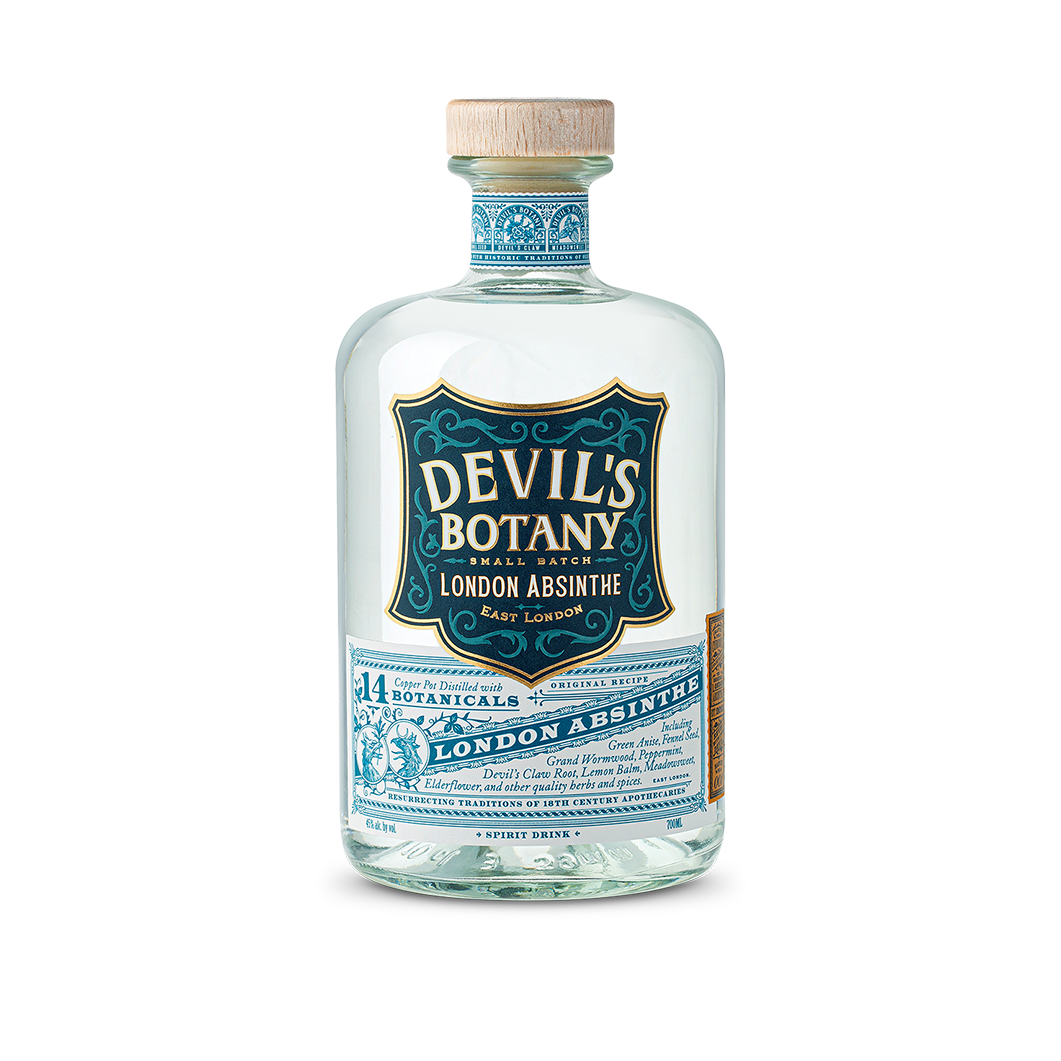
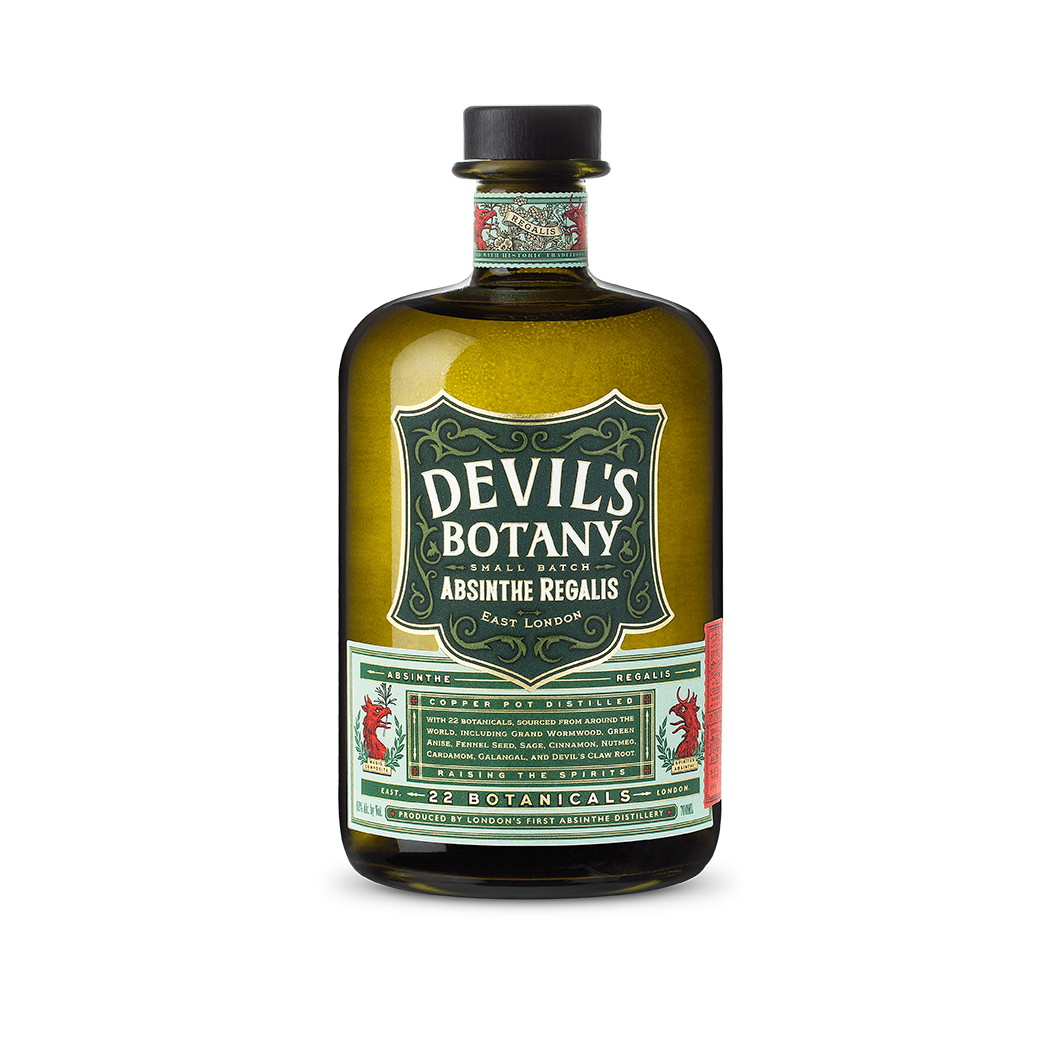
Beyond the trinity, absinthe is an open canvas. Distillers add their own selection of botanicals — lemon balm, hyssop, coriander, angelica root, petite wormwood, etc — to build complexity and a distinct house character. At Devil's Botany, our London Absinthe uses 14 botanicals including meadowsweet and elderflower native to the East London landscape around our distillery. Our Absinthe Regalis draws on 22 botanicals sourced from London's 18th century apothecary tradition.
Absinthe is typically bottled between 45% and 75% ABV — significantly stronger than most spirits — and is always diluted before drinking. This isn't about taming the alcohol; it's about unlocking the flavour. Water triggers the louche, releasing the aromatic essential oils trapped in the botanicals and transforming the liquid in the glass.
The short version: Absinthe is a botanical spirit like gin, surrounded by ritual like whisky, and more misunderstood than anything else in the drinks world. It will not make you hallucinate. It will, if you let it, become the most interesting thing in your drinks cabinet.
What separates great absinthe from poor absinthe is the same thing that separates great gin from poor gin: the quality of the botanicals, the skill of the distillation, and the courage to use real ingredients rather than artificial flavourings. If your absinthe glows neon green and doesn't louche, put it down and walk away.
02 — A Short, Turbulent History of the Green Fairy
No spirit has had a stranger journey. Absinthe was born as medicine, became a symbol of artistic liberation, was banned across the Western world, spent nearly a century in exile, and is now in the middle of a genuine renaissance. This is that story.
17th Century — Nicholas Culpeper
Distilled liquor became the preferred vehicle for extracting the quintessence — the fifth essence — of nature's botanicals. Sourced from across the globe, the world's most delectable herbs and spices were distilled into the herbal elixirs of the city's apothecaries. Nicholas Culpeper, the well-known seventeenth century apothecary, published a translation of recipes for distilled elixirs from Latin to English so that all the people of Britain could be privy to such wisdom. Wormwood's virtues were so well known in Britain that when describing it, Culpeper's description simply reads:
"Every boy that can eat an egg knows of grand wormwood."
— Nicholas Culpeper, 17th century apothecary
18th Century — The Curious Apothecaries of Old London
The eighteenth century was deemed a golden age for apothecaries in London. Eccentric figures and merry rascals — the curious apothecaries of Old London were early mixologists in their own right and among the first professional distillers. The apothecary's place of business became a one-stop shop for distilled spirits, wine, herbs, spices, and sugar. Their distilled elixirs of wormwood and aniseed were widely consumed across Britain for both their cordial properties and agreeable flavour.
1712 — The Apothecary's Cocktail
The history of mixing drinks owes much to the weird and wonderful apothecaries. From the herbal elixirs of London's 18th century apothecary shops, the history of classic cocktails emerged. The earliest recipe for the cocktail as it is known today was described in a New York newspaper on 13 May 1806 as "a stimulating liquor, composed of spirits of any kind, sugar, water and bitters." The origins of this inebriating pick-me-up can be traced back to the apothecary shops of London a century earlier.
1719 — London's Forgotten Absinthe Recipe
While the world has long believed absinthe's story began in Switzerland in 1797, Devil's Botany Distillery spent over half a decade researching the spirit's origins — and found something hiding in the recipe books of London's apothecaries that changed that story entirely.
"Hidden within the recipe books of London's apothecaries, we found an 18th century recipe for an early precursor to absinthe that predates the first Swiss or French distilleries by nearly a century."
— Allison Crawbuck, Co-Founder, Devil's Botany Distillery
Nearly a century before the first commercial absinthe distillery opened in Switzerland, London's dram-drinkers were already enjoying an early precursor to absinthe made by the city's apothecaries. Praised for its revitalising flavour, this noble aperitif was found most effective in raising the spirits of Londoners — and it had been doing so for decades before the Swiss or French claimed the spirit as their own.
The 1719 recipe called for absinthe's holy trinity of grand wormwood, green anise, and fennel seed — plus imported luxury spices including cinnamon, cardamom, and nutmeg. The resulting distillate would have been a clear-style absinthe, sold across Britain by apothecaries alongside gin, brandy, and rum — enjoyed not just medicinally, but recreationally.
"These botanicals have appeared in alcoholic elixirs since ancient days, but would have started as infusions in beer or wine — giving us early examples of bitter ale and vermouth. After apothecaries mastered the alchemical art of distillation, spirits became the preferred vehicle for administering their botanical elixirs."
— Allison Crawbuck
This once-forgotten recipe is the direct inspiration for Devil's Botany Absinthe Regalis. Distilled in East London with the original holy trinity plus cinnamon, cardamom, and nutmeg, and coloured naturally using milk thistle and white dead nettle found growing wild across London, Absinthe Regalis resurrects what London's apothecaries were making 300 years ago — with a modern distiller's precision.
"Distilled with absinthe's holy trinity of grand wormwood, green anise and fennel seed, the original recipe that we found from 1719 also called for imported spices such as cinnamon, cardamom and nutmeg, which were all once symbols of luxury. The resulting distillate would have provided a clear-style of absinthe, but we coloured our recipe for Absinthe Regalis naturally using local botanicals, such as milk thistle and white dead nettle that can be found growing wild across London, to create an emerald green absinthe that is deeply herbaceous and luxuriously spiced."
— Rhys Everett, Co-Founder & Distiller, Devil's Botany Distillery
1792 — The birth of Swiss absinthe
Dr Pierre Ordinaire, a French physician living in the Swiss Val-de-Travers, creates an elixir of wormwood and botanicals as a cure-all tonic. The recipe eventually reaches Major Henri-Louis Pernod, whose distillery in Pontarlier becomes the centre of absinthe production in Europe.
1840s — The French Foreign Legion
The French army in Algeria is given absinthe as a malaria preventative and general tonic. Soldiers return home with a taste for it. Within a decade absinthe is the most fashionable drink in Parisian cafés, and the late afternoon hour when it was traditionally consumed becomes known as l'heure verte — the green hour.
1860–1900 — The Belle Époque
Absinthe becomes inseparable from Parisian bohemian culture. Verlaine, Rimbaud, Baudelaire, Toulouse-Lautrec, Manet, Degas, Van Gogh, and Oscar Wilde all drink it, write about it, or paint it. The spirit acquires its mythological alter ego — La Fée Verte, the Green Fairy — as muse and devil's companion in equal measure. By 1900, France is producing over 220 million litres a year.
"After the first glass, you see things as you wish they were. After the second, you see things as they are not. Finally you see things as they really are, and that is the most horrible thing in the world."
— Oscar Wilde
1905 — The case that changed everything
Swiss labourer Jean Lanfray murders his family after drinking absinthe — though records show he also consumed considerable wine and brandy that day. The temperance movement seizes on the absinthe and ignores everything else. The "Lanfray Affair" becomes the rallying point for prohibition campaigns across Europe.
1915 — The ban
France bans absinthe. Switzerland, the United States, Belgium, and the Netherlands follow. The wine and spirits lobby — threatened by absinthe's commercial dominance — quietly funds much of the campaign. A century of exile begins. The United Kingdom, notably, never bans it.
1990s — The Czech misstep
The absinthe "revival" begins — but badly. Czech-style absinthes made without traditional botanicals and designed to be set on fire flood the market. The flaming ritual, never part of authentic absinthe tradition, is invented as a marketing gimmick. A generation of drinkers is put off by syrupy, artificially coloured spirits that bear no relation to the real thing.
2005–2011 — The real revival
The bans fall. France lifts restrictions in 2011. The United States legalises properly made absinthe in 2007. Distillers begin making authentic pre-ban style absinthes, and a community of serious absinthe drinkers — using the French drip method, sourcing proper glassware, and seeking quality over spectacle — begins to grow in earnest.
2021 — Devil's Botany opens
The UK's first dedicated absinthe distillery opens in Leyton, East London — built by the team behind The Absinthe Parlour at The Last Tuesday Society, London's foremost absinthe bar. The British chapter of absinthe's story finally gets its own distillery.
03 — The Botanicals
Absinthe is a botanical spirit, which means the flavour comes entirely from plants. Understanding the key botanicals is the first step to understanding why absinthes taste so different from one another — and how to find the style you prefer.
The Holy Trinity
These three botanicals are non-negotiable. Any spirit calling itself absinthe must contain them.
Grand Wormwood (Artemisia absinthium)
The defining botanical. Bitter, medicinal, and complex — the source of absinthe's characteristic bitterness and much of its herbal depth. Also the source of thujone, the compound that led to absinthe's mistaken reputation. Modern science has cleared wormwood's name. It is no more dangerous than any other bitter herb used in spirits or food.
Green Anise (Pimpinella anisum)
Responsible for absinthe's distinctive anise flavour and, crucially, for the louche. The essential oils in green anise are soluble in high-strength alcohol but not in water, so they precipitate out as a beautiful opalescent cloud when water is added. Green anise is the primary driver of the louche effect.
Sweet Fennel (Foeniculum vulgare)
Adds a softer, sweeter anise note that rounds out the sharpness of green anise. Also contributes to the louche. Without fennel, absinthe would be harsher and more medicinal. Fennel is the diplomat of the trinity, smoothing over wormwood's bite and anise's sharpness.
Secondary Botanicals
These are typically added after distillation in a process called colouration, to give absinthe its characteristic green colour and additional flavour layers. Their volatile chlorophyll degrades over time, which is why older absinthes turn amber — a mark of quality and age, not spoilage.
Petit Wormwood (Artemisia pontica) — Roman wormwood, lighter and more delicate than grand wormwood. Used in the colouration stage to build the characteristic green colour and a secondary layer of bitter herbal complexity.
Hyssop (Hyssopus officinalis) — A member of the mint family with an intensely aromatic, slightly camphor character. A key colouration botanical in many traditional absinthes.
Lemon Balm (Melissa officinalis) — Bright citrus notes and a gentle floral quality. Used in Devil's Botany's London Absinthe to give a fresh, distinctly British character.
Devil's Botany's Distinctive Botanicals
At our Leyton distillery, we go beyond the traditional French and Swiss recipes. Our London Absinthe incorporates botanicals native to the East London landscape — meadowsweet and elderflower that grow near the distillery — giving it a character that is unmistakably British. Our Absinthe Regalis draws on the spice trade history of London, using nutmeg, cinnamon, cardamom, and galangal from the same sources 18th century apothecaries would have used.
Meadowsweet (Filipendula ulmaria) — A classic English hedgerow flower with a honey-almond scent. Used in our London Absinthe to give a distinctly British meadow character.
Devil's Claw Root (Harpagophytum procumbens) — A southern African root with a deeply bitter, complex character. Its name gave us ours. Devil's Claw adds medicinal depth to the base wormwood bitterness — a direct nod to absinthe's origins as an apothecary tonic.
Elderflower (Sambucus nigra) — Quintessentially English. In our London Absinthe, elderflower adds a soft floral lift to the finish — the botanical equivalent of a British summer afternoon. Counterintuitive in absinthe; perfect in ours.
04 — How to Drink Absinthe
Absinthe has a ritual. This is not pretension — it is chemistry. Adding cold water slowly to absinthe isn't ceremony for ceremony's sake; it's the process by which the essential oils in the botanicals are released, the louche forms, and the flavours fully open. Rush it and you miss the point.
There are two traditional methods. Both are correct. Neither involves setting anything on fire.
The French Drip — Traditional Method
The classic method, and the most theatrical. What you need: an absinthe glass, an absinthe spoon, a sugar cube, and a carafe of cold water.
Step I — Pour the absinthe. Pour 30–50ml into your glass. A proper absinthe glass has a reservoir at the base that marks the measure. Use a cold glass if possible.
Step II — Rest the spoon. Place your absinthe spoon across the rim of the glass. These perforated spoons support the sugar cube and allow water to drip through slowly. A regular teaspoon works perfectly well if you don't have one.
Step III — The sugar (optional). Place a sugar cube on the spoon. Traditional absinthes were often bitter enough to require sweetening; good modern absinthes are balanced without it. Try yours without sugar first — if it's well-made, you may prefer it that way.
Step IV — Add cold water. Slowly. Drip ice-cold water over the sugar and into the glass. Three to five parts water to one part absinthe is the traditional ratio. As the water meets the absinthe, watch the louche form. This is the moment. The slower the water, the more beautiful the transformation.
Step V — Drink. No ice in the glass. No garnish. No further theatre. Taste the spirit slowly — the anise is first, then the wormwood bitterness appears in the mid-palate, and the botanicals open on the finish. Absinthe reveals itself gradually. It rewards patience.
The Swiss Method — Without Sugar
Purists in the Val-de-Travers — where absinthe was born — never used sugar. Cold water is dripped directly into the absinthe over a spoon with no sugar cube, at the same 1:3–5 ratio. The result is slightly more bitter and herbal, which is precisely the point. For whisky drinkers or anyone who appreciates a spirit's botanical character clearly, this is the method that lets absinthe speak most honestly.
The Absinthe Fountain
Dedicated absinthe bars use a fountain — a decorative vessel filled with iced water, fitted with taps that allow a precise, consistent drip. Multiple drinkers can prepare their glasses simultaneously, each with their own tap. The fountain is an object of considerable beauty and one of the reasons to visit The Absinthe Parlour at The Last Tuesday Society.
A note on the flaming ritual: Pouring absinthe over a sugar cube and setting it alight is a 1990s Czech invention with no basis in absinthe tradition. It burns off the most aromatic compounds, destroys the louche, and makes the drink worse. Any bar that suggests this is either uninformed or performing for tourists.
05 — The Louche & The Colour
The louche — from the French loucher, meaning to squint or go cross-eyed — is the opalescent cloud that forms when cold water meets absinthe. It is, without exaggeration, one of the most visually extraordinary phenomena in the world of spirits, and it tells you everything you need to know about the quality of what you're drinking.
The science: the essential oils in absinthe's botanicals — anethole from anise and fennel, thujone from wormwood — are soluble in high-strength alcohol but not in water. As the spirit is diluted, these oils fall out of solution and form microscopic droplets suspended in the liquid. These droplets scatter light, creating the characteristic milky, swirling cloud.
A great louche is dense, billowing, and slow to form. It begins at the point where water meets spirit — a thin thread of cloud that thickens and expands as dilution increases. Watching it form properly, with cold water dripped slowly from a fountain, is unhurried and absorbing. It changes the colour of the liquid: a clear absinthe becomes milky white; a green verte shifts towards pale jade.
Colour tells a different story. Real absinthe gets its colour from chlorophyll — the natural pigment in the botanicals. That green is alive, and it behaves like something alive: it fades. Exposure to light gradually turns a genuine green absinthe to amber. This is not spoilage. It is proof. Artificial colouring doesn't fade — the neon stays neon, a reliable indicator that the bottle contains no genuine botanical character worth protecting.
Our Absinthe Regalis is naturally coloured. Store it away from light and it will deepen and mellow over time. Our London Absinthe is intentionally clear — distilled to London Dry rules, nothing added post-distillation. What you see is what was distilled.
"The louche is the spirit's way of showing you what's inside it. Every botanical you can taste was once visible in that cloud."
— Allison Crawbuck, Co-founder, Devil's Botany Distillery
06 — Myths vs Reality
No spirit has been more lied about than absinthe. Most of what you've heard is wrong, and the lies served specific interests — the wine lobby, the temperance movement, and later the marketing departments of cheap spirits brands. Here is the truth.
Myth: Absinthe makes you hallucinate.
Reality: Comprehensively disproved by modern science. The thujone levels in properly made absinthe — typically 10mg/kg or less, as required by EU regulations — are far too low to have any psychoactive effect. You would need to consume a fatal quantity of alcohol before thujone became an issue. The "madness" associated with 19th century absinthe drinkers was alcoholism, which affects drinkers of every spirit equally.
Myth: The flaming ritual is traditional.
Reality: It was invented in the Czech Republic in the 1990s as a marketing gimmick for low-quality spirits. It has no basis in absinthe history, destroys the most volatile aromatic compounds, and makes the drink worse. The traditional methods — the French drip and the Swiss drip — have been used for over two centuries for good reason.
Myth: Absinthe was banned because it was genuinely dangerous.
Reality: Absinthe was banned primarily due to a political campaign funded by the wine and spirits industry, who saw it as a commercial threat, combined with a moral panic stoked by one high-profile murder case. The Lanfray case — used as the template for prohibition — involved a man who had consumed significant quantities of wine and brandy before any absinthe. Wine remained legal everywhere absinthe was banned.
Myth: Real absinthe is neon green. The colour means quality.
Reality: Neon green absinthe is almost always artificially coloured. Authentic absinthe gets its colour from natural chlorophyll in the botanical colouration step — typically a softer, more complex green that fades to amber over time. A naturally coloured absinthe turning amber is a sign of quality and age. It means real herbs were used.
Myth: All absinthes taste the same.
Reality: The flavour variation between quality absinthes is enormous. The botanical recipe, distillation method, water source, colouration step, and ABV all dramatically affect the character. Compare a Swiss blanche to a Pontarlier verte to a British botanical absinthe and you are tasting genuinely different spirits — no more alike than a Speyside malt and an Islay whisky.
07 — Why the UK Never Banned Absinthe
Here is a fact that surprises almost everyone: absinthe was never illegal in the United Kingdom. While France, Switzerland, the United States, Belgium, and most of the Western world banned the spirit in the early 20th century, Britain declined to follow. There was no British Absinthe Prohibition. The Green Fairy was always welcome here.
The reasons are partly political — the British temperance movement had different targets and the winemakers' lobby had less influence in Westminster — and partly practical. Absinthe, while fashionable in certain circles, never reached the mass consumption levels it did in France, where by 1910 it had become the drink of the working class as well as the bohemian elite.
The consequence is extraordinary. While French and Swiss distillers lost decades of knowledge and tradition to prohibition — recipes abandoned, stills dismantled, expertise scattered — British bartenders simply kept using absinthe. The great cocktail books of the 1920s and 30s, many published in London, call for absinthe in dozens of recipes. The iconic Savoy Cocktail Book of 1930 uses absinthe in over 100 recipes. The Café Royal Cocktail Book of 1937 calls for it in nearly 40 more.
This means British bartending has an unbroken connection to genuine absinthe use — a living tradition that was never interrupted by law. When absinthe's reputation was rebuilt in the early 21st century, British bars were well placed to lead the revival. The Absinthe Parlour at The Last Tuesday Society became the most celebrated absinthe bar in the country; it was there that Devil's Botany was conceived, and from there that the UK's first dedicated absinthe distillery grew.
The British absinthe tradition is unique in the world. Unlike France, where the spirit had to be rediscovered and relearned after a century's absence, British bartending maintained an unbroken relationship with absinthe from its 19th century origins to the present day. This is the tradition Devil's Botany distils from.
08 — Absinthe Cocktails
Absinthe is both a standalone drink and one of the most useful spirits in the cocktail arsenal. Used in small quantities it adds herbal depth and complexity that transforms a drink; used as the base it creates something genuinely distinctive. The classic cocktails that use absinthe are among the greatest ever created — designed by bartenders who had access to good absinthe and knew exactly what it could do.
The Sazerac
New Orleans, c.1850 — the oldest known American cocktail
50ml rye whiskey · 5ml absinthe (rinse) · 5ml sugar syrup · 2 dashes Peychaud's bitters · lemon peel to express
Rinse a chilled glass with absinthe. Stir the remaining ingredients over ice and strain into the glass. Express lemon peel over the top and discard. The absinthe rinse is everything — its role is aromatic, and it transforms the drink entirely.
Corpse Reviver No. 2
Savoy Cocktail Book, London, 1930
25ml gin · 25ml Cointreau · 25ml Lillet Blanc · 25ml lemon juice · 5ml absinthe (rinse)
Rinse a chilled coupe with absinthe. Shake all remaining ingredients hard over ice and double-strain into the glass. One of the great breakfast cocktails — which tells you everything about London in the 1930s.
Death in the Afternoon
Ernest Hemingway, 1935
30ml absinthe · chilled Champagne to top
Pour the absinthe into a Champagne flute. Top slowly with cold Champagne. Hemingway's instructions were to drink three to five of these slowly. This drink louches beautifully as the Champagne hits the absinthe. Simple, theatrical, and extremely effective.
Monkey Gland
Harry MacElhone, Paris, 1923
40ml gin · 30ml orange juice · 5ml grenadine · 5ml absinthe
Shake all ingredients hard over ice and double strain into a chilled coupe. A classic of the pre-war era that shows how a small measure of absinthe transforms the character of a drink without dominating it.
The Mazarin — Devil's Botany Original
50ml Absinthe Regalis · 50ml chilled water · 10ml simple syrup · 1 dash Angostura bitters
Stir well over ice until very cold. Strain into a chilled glass. A sophisticated, contemplative serve that lets the 22-botanical complexity of Absinthe Regalis speak clearly, with bitters adding a further herbal dimension.
Absinthe Highball
50ml London Absinthe · 150ml elderflower tonic · 2 cucumber slices · plenty of ice
Build over ice in a tall glass. Stir gently. The elderflower tonic echoes the elderflower in our London Absinthe; cucumber adds freshness. The most accessible entry point for absinthe-curious drinkers, and one of the most refreshing long drinks you can make.
For the complete Devil's Botany cocktail collection, visit our Serves page.
09 — Types of Absinthe
Not all absinthes are alike. The major styles are defined by their production method, colour, and character — and each suits different occasions and preferences.
Verte — Green Absinthe
The classic, and what most people picture. Verte absinthes undergo a colouration step after distillation, in which the spirit is macerated with additional green herbs — typically hyssop, lemon balm, and petite wormwood. These impart both the green colour (from natural chlorophyll) and additional flavour complexity. A well-made verte is the most botanically layered style of absinthe. Its colour fades from green to amber as it ages — a mark of quality, not deterioration. Our Absinthe Regalis is a verte.
Blanche — Clear Absinthe
Blanche absinthe skips the colouration step, leaving the spirit crystal clear. The style originated in Switzerland, where distillers hiding from prohibition produced clear absinthe that could pass for water. Blanches tend to be cleaner, crisper, and more immediately approachable — the botanicals read clearly without additional colouration complexity.
Rosé and Coloured Absinthes
A newer category, using botanicals like rose, hibiscus, or other flowering plants to create naturally coloured expressions at lower ABV. Devil's Botany's Rose Absinthe Liqueur uses this approach — a 24% ABV expression with rose botanical colouration, designed as a gateway into absinthe for curious drinkers.
Barrel-Aged Absinthe
A small but growing category. Absinthe rested in wood takes on vanilla, caramel, and spice from the cask. Devil's Botany's Bourbon Barrel-Aged Absinthe rests our base spirit in ex-bourbon casks, creating a complex expression with all the botanical character of our core range plus the influence of American oak.
At a glance:
Green — Green to amber with age · Complex, herbal, layered · Best served via the French drip ritual
Clear — Crystal clear · Clean, crisp, botanical · Best in cocktails or the Swiss drip
Rosé — Pink to deep red · Floral, softer, accessible · Best neat, over ice, or as a spritz
Barrel-aged — Amber to dark gold · Botanical plus vanilla and caramel · Best neat or as a Sazerac base
The London Absinthe — Modernising a Category
For centuries, the louche has been absinthe's defining moment — the opalescent cloud that forms when cold water meets spirit, the proof of real botanicals, the ritual that separates absinthe from every other drink. It is beautiful, theatrical, and one of the things we love most about the category.
So why did we make an absinthe that doesn't do it?
Devil's Botany London Absinthe is the world's first absinthe to adopt the strict production regulations that define a London Dry Gin — and the result is something the category has never seen before: a crystal-clear absinthe that stays brilliantly clear when mixed with water, while delivering the full botanical intensity that defines a great absinthe.
What Makes It Different
Traditional absinthe louches because its essential oils — released during distillation and carried into the bottle at high ABV — fall out of solution when water is added. This is the chemistry of the louche, and it is a mark of quality in a traditionally made spirit.
Devil's Botany London Absinthe starts from a different set of questions. Rather than asking how do we make the best traditional absinthe, we asked: what would absinthe look like if it was invented in London today, by distillers who also make gin?
The answer is a spirit that follows London Dry Gin's rules precisely:
100% natural botanicals. Grand wormwood, green anise, fennel seed — the holy trinity — plus meadowsweet, elderflower, peppermint, lemon balm, and Devil's Claw Root. Fourteen botanicals in total, all added during distillation. Nothing artificial. Nothing added post-distillation except water.
No sugar added. Traditional absinthe is a spirit, not a liqueur. London Absinthe follows the same rule — bone dry, botanical-forward, nothing to mask what's inside.
Precise heart cuts. A slow distillation process with careful cuts ensures only the highest quality liquid goes into each bottle. The result is crystal clarity — not as a stylistic choice, but as a consequence of exceptional distillation.
Why It Matters for a New Generation
The louche is extraordinary — but it has also been a barrier. The ritual, the glassware, the fountain, the sugar cube — for drinkers who grew up with gin and tonic, craft beer, and natural wine, absinthe's ceremony can feel like homework before you're allowed to enjoy your drink.
Devil's Botany London Absinthe removes that barrier without removing any of the flavour. It is an absinthe you can pour straight into a highball glass with tonic and ice, or stir into a martini, or mix into a Negroni — and it behaves exactly as you'd expect a premium botanical spirit to behave. No louche. No ritual required. No explanation needed to the person next to you at the bar.
"We're not just making absinthe — we're unleashing its future. Devil's Botany is breaking the mould of the spirit category, fusing fearless innovation with botanical rebellion to ignite a new absinthe era for rule-breakers, risk-takers, and the creatively curious."
— Devil's Botany Distillery
This matters commercially too. The single biggest obstacle to growing absinthe's share of the UK spirits market is not flavour — it is occasion. Absinthe has been positioned as a special ritual drink, which means it gets ordered once and never becomes a habit. London Absinthe is designed to sit where gin sits: behind every bar, in every fridge, mixed into everyday drinks by people who have no idea they're drinking absinthe — and love it.
Two Absinthes. One Distillery. Two Different Conversations.
Devil's Botany makes both. Absinthe Regalis is the traditional expression — verte, louching, ritual-worthy, inspired by an 18th century London apothecary recipe. London Absinthe is the modern one — clear, versatile, gin-drinker-friendly, and built for the back bar of 2026.
They represent two sides of the same mission: to make absinthe the most interesting category in British spirits, for the drinkers who already love it and the ones who don't know they love it yet.
Discover Devil's Botany London Absinthe →
10 — How to Buy the Best Absinthe in the UK
The UK market for quality absinthe has never been better. But not all bottles on shelves are worth your money. Here is what to look for — and what to avoid.
What to Look For
Natural colour. Avoid anything neon green. Authentic absinthe gets its colour from real botanicals; artificial colouring is a reliable indicator of an artificial product.
A genuine louche. If you can, test a small amount with cold water. A dense, beautiful louche means real botanicals. No louche means artificial flavouring.
Botanical transparency. Good producers list their botanicals. If a label says only "wormwood, anise, fennel" with no further detail, it is likely making the absolute minimum. Look for distillers who are proud of what's inside.
ABV. Anything under 45% is not absinthe — it's an anise spirit. Authentic absinthe sits between 45% and 75%. Most quality expressions are between 55% and 68%.
The Devil's Botany Range
As the UK's first and only dedicated absinthe distillery, we make every expression from scratch at our Leyton distillery using copper pot distillation and the finest available botanicals. Every bottle in our range louches beautifully, is naturally coloured, and is made to be drunk.
London Absinthe — £34.95
Clear · 45% ABV · 14 botanicals. Our core expression. The definitive British absinthe — crisp, herbal, floral, and unmistakably London-made. The best starting point in the range.
Absinthe Regalis — £49.95
Green · 55% ABV · 22 botanicals. Inspired by the recipe books of 18th century London apothecaries. More complex, more contemplative, longer on the finish. The absinthe for serious drinkers.
Bourbon Barrel-Aged Absinthe — £59.95
Aged verte · 55% ABV. Our Absinthe Regalis rested in ex-bourbon casks. Botanical complexity meets vanilla, caramel, and American oak. Limited availability.
Rose Absinthe Liqueur — £29.95
Rosé · 24% ABV. Lower ABV, naturally coloured, ready to drink neat or over ice. The perfect introduction to the world of absinthe.
Shop the full Devil's Botany range →
Devil's Botany is the UK's first dedicated absinthe distillery, based at 16a Heybridge Way, Leyton, East London, E10 7NQ. The distillery is open every Saturday 12–6pm. Questions? Write to us at info@devilsbotany.com. Summon responsibly.
Products
Discover the award-winning Devil's Botany range of botanical spirits & liqueurs.